
Nebraska EV Charger Rebates: OPPD, LES & the Only 100% Public-Power State
Nebraska is unique — the only state where every kilowatt-hour comes from a public power district, irrigation district, or municipal utility. No investor-owned utilities, no shareholder return targets baked into rates. That structural difference is why OPPD’s $200–$300 charger rebate in Omaha and LES’s $200 in Lincoln aren’t marketing programs — they’re ratepayer-funded reinvestment. Stack with the federal 30C credit (~90% of Nebraska tracts qualify under rural or energy-community designation) and most installs land below $500 out-of-pocket. Plan for ice-storm grid resilience and the panhandle’s -20°F winter lows.
Important: Rebate programs, amounts, and eligibility requirements change frequently. The information on this page was last verified on July 7, 2026. Always confirm current availability directly with your utility company or state energy office before making purchasing decisions.
Nebraska EV Charger Incentive Overview
Nebraska is the only U.S. state with 100% public power. Every electricity provider in the state is either a public power district, an irrigation district, or a municipal utility — the result of a 1933 reform act that displaced investor-owned utilities entirely. That structural fact shapes the rebate landscape: programs are funded by ratepayer reinvestment, not shareholder marketing budgets, and tend to be smaller-dollar but more stable across program cycles.
The two retail-scale rebate utilities are OPPD (Omaha) and LES (Lincoln), covering roughly 60% of state EV registrations between them. NPPD is the wholesale-only generation and transmission provider that sells to roughly 80 local distribution utilities scattered across rural Nebraska. There’s no state rebate, no state credit, and the 6.84% top state income tax bracket has no EV-related carve-out. Recent legislation (LB 30, 2023) directed Public Service Commission attention to EV charging infrastructure but didn’t create residential incentives.
Nebraska EV Charger Incentive Summary
| Incentive Type | Available? | Amount |
|---|---|---|
| State Tax Credit | No | N/A |
| State Rebate Program | No | N/A |
| Federal 30C Tax Credit | Yes | Up to $1,000 (~90% of NE qualifies) |
| OPPD baseline + enhanced | Yes | $200–$300 |
| LES rebate | Yes | $200 |
| NPPD / local district programs | Limited | Varies by district |
| Nebraska EV registration fee | Yes (cost) | −$75/yr |
Statewide EV registration sits around 8,000 vehicles, concentrated in Douglas County (Omaha), Lancaster County (Lincoln), and Sarpy County (Bellevue, Papillion). Western Nebraska adoption is slower but growing in oil/agricultural communities like Sidney, Scottsbluff, North Platte, and McCook.
Federal Tax Credit in Nebraska: The Stacking Lead
Nebraska’s 30C math runs on a stacking sequence: utility rebate first, then 30% federal credit on net cost. Skipping the order means filing Form 8911 with the wrong basis and risking audit adjustment. Our federal credit guide walks through 8911 line-by-line.
Stacking Sequence: How to Get It Right
- Pay gross install cost upfront: $300 charger + $700 install + $50 permit = $1,050 typical Omaha install
- Submit OPPD rebate: Receive $200–$300; this reduces your net cost
- Calculate 30C basis: Net cost = gross minus utility rebate. $1,050 − $300 = $750 net
- Apply 30% credit: $750 × 30% = $225 federal credit
- Total stacking: $300 utility + $225 federal = $525 in combined incentives, $525 out-of-pocket
The temptation is to claim 30% of gross ($315) instead of net ($225). Don’t. The IRS reads Form 8911 with utility rebates netted off, and Nebraska’s OPPD/LES rebates are clearly identified rebate income that reduces basis.
Nebraska Energy-Community Map
Approximately 90% of Nebraska tracts qualify under at least one 30C path. The eligibility breakdown:
- Western Nebraska oil tracts: Cheyenne, Kimball, Banner, Morrill, Scotts Bluff counties have meaningful oil and gas employment qualifying as energy communities
- Ethanol corridor: Plants in Buffalo, Hall, Hamilton, Adams, and York counties qualify under expanded energy-sector employment definitions
- Sandhills and rural Nebraska: Almost all tracts qualify under the non-urban tract designation independently
- Wind-development counties: Holt, Knox, Antelope, Cedar, Wayne, Stanton counties have growing wind employment
- Native American reservations: Omaha, Winnebago, Santee Sioux, Ponca tracts qualify trivially
The ineligible cluster sits in inner Omaha (Old Market, Dundee, parts of Benson), midtown Lincoln (Country Club, Near South), and the higher-income Sarpy County tracts around La Vista and west Papillion. Run your address through the IRS eligibility tool — suburban Omaha is one of the regions where eligibility flips block by block.
State Tax Stack
Nebraska’s graduated state income tax runs from 2.46% to 6.84% (top bracket above ~$36K single, ~$72K married filing jointly). No EV charger credit, deduction, or rebate at the state level. The federal 30C is the only tax-based incentive.
OPPD Charger Rebate: Omaha Metro Mechanics
OPPD (Omaha Public Power District) is Nebraska’s largest retail electric utility, serving roughly 400,000 customers across Omaha, Bellevue, La Vista, Papillion, Council Bluffs (Iowa side), Plattsmouth, and most of eastern Nebraska. As a public power district, OPPD operates under a board of seven elected directors representing customer-ratepayer constituencies — not shareholders.
OPPD EV Charger Rebate
- Baseline rebate: $200 for qualifying Level 2 EVSE
- Enhanced rebate: Up to $300 with managed-charging program participation
- Customer requirement: Active OPPD residential account, registered EV at install address
- Equipment requirement: Qualifying Level 2 EVSE on OPPD’s approved-equipment list (networked features required for the enhanced tier)
- Submission: OPPD EV portal; charger receipt, electrician invoice, EV registration, account number
Public Power Funding Stability
OPPD’s rebate program is funded through the rate base, not as marketing expense. That has two practical implications: program funding tends to roll year-over-year without surprise pauses, and program rules don’t shift abruptly to manage shareholder return targets. Compared to many investor-owned utility EV programs that pause mid-year when budgets exhaust, OPPD has historically maintained more predictable program availability.
OPPD TOU & Time-Differentiated Rates
OPPD has piloted time-of-use rate options for residential customers including EV-targeted overnight off-peak windows. Annual savings for an EV owner shifting load to overnight typically run $150–$300. Verify the current TOU offerings via OPPD’s rate-design portal — pilot programs evolve year to year.
Real Stacked Math: Omaha Standard Install
| Cost Component | Amount |
|---|---|
| Grizzl-E Classic Charger | $300 |
| Omaha electrician install (40-amp circuit, 30 ft run) | $700 |
| City of Omaha permit | $50 |
| Gross Total | $1,050 |
| OPPD Enhanced Rebate (managed tier) | −$300 |
| Net cost subject to 30C | $750 |
| Federal 30C Credit (eligible tract) | −$225 |
| Out-of-pocket after stacking | $525 |
Drop the OPPD tier to baseline ($200) and the math becomes: $200 OPPD + $255 30C (30% of $850 net) = $455 stacked, $595 out-of-pocket. Drop 30C eligibility (inner-Omaha tract not qualified) and out-of-pocket rises to $850.
Cooper Nuclear Station
The Cooper Nuclear Station near Brownville in Nemaha County is Nebraska’s only operational nuclear plant (Fort Calhoun retired in 2016). Cooper’s employment base places Nemaha County and adjacent tracts in energy-community status for 30C purposes. Brownville, Nebraska City, Auburn, and surrounding rural addresses qualify trivially regardless of any other path.
LES, NPPD & Other Public Power Districts
Nebraska’s public power structure includes roughly 80 distribution utilities. OPPD and LES are the two dominant retail-scale providers; NPPD serves wholesale to most of the rest.
| Utility | Service Area | EV Programs | Notes |
|---|---|---|---|
| OPPD | Omaha metro, eastern NE | $200–$300 | Largest retail PPD |
| LES | Lincoln, Lancaster County | $200 | Municipal utility |
| NPPD | Statewide wholesale | Wholesale only | Doesn’t serve retail |
| MEAN (Municipal Energy Agency of Nebraska) | ~70 small munis | Limited | Wholesale + admin |
| Norris Public Power District | Beatrice, Gage County | Limited | Local PPD |
| South Sioux City municipal | South Sioux City | Varies | Member of MEAN |
| Scottsbluff municipal | Scottsbluff (panhandle) | Varies | Member of MEAN |
LES (Lincoln Electric System)
LES is a city-owned municipal utility serving Lincoln (Nebraska’s second-largest city) and most of Lancaster County. The $200 EV charger rebate is available to LES residential customers with an active EV. As a municipal utility under city government oversight, LES tends to follow Lincoln city sustainability goals closely. Apply through the LES customer portal.
Lincoln tracts are mixed for 30C eligibility. The Highlands, Country Club, and Near South tracts often don’t qualify; North Lincoln, the University of Nebraska area, and rural Lancaster County tracts typically do. Check your specific address.
NPPD & Local Distribution
NPPD (Nebraska Public Power District) is the state’s largest wholesale electricity provider but doesn’t serve retail customers directly. NPPD wholesales to local PPDs and municipal utilities scattered across rural Nebraska. Retail EV programs are administered by the local distribution utility, which means a Hastings customer (City of Hastings utility) and a Norfolk customer (Norfolk Public Power) might face entirely different rebate options. Contact your local PPD directly.
MEAN Municipal Members
The Municipal Energy Agency of Nebraska represents roughly 70 small municipal utilities across the state — Beatrice, Crete, Holdrege, Imperial, McCook, Schuyler, Scottsbluff, South Sioux City, Wayne, West Point, and many smaller. Most don’t run dedicated EV charger rebates. Western panhandle members serve oil/agricultural communities where federal 30C eligibility is essentially universal.
Identifying Your Nebraska Utility
Pull your bill. Omaha, Bellevue, La Vista, Papillion = OPPD. Lincoln = LES. Other cities = local PPD or municipal. Rural addresses = local PPD or member co-op.
Installation Costs & Ice-Storm Realities
Nebraska electrician labor runs $70–$100/hr in Omaha and Lincoln, lower in smaller cities and rural counties. Total install costs sit comfortably below the national median.
| Installation Type | Typical Cost Range | Notes |
|---|---|---|
| Simple install (panel within 15 ft) | $350–$600 | Existing 240V capacity, attached garage |
| Standard install | $600–$1,200 | New 40-amp circuit, 30–50 ft run |
| Complex install | $1,200–$2,200 | Panel upgrade, long run, detached garage |
| Western panhandle install | +$100–$250 | Travel charge from nearest licensed electrician |
Omaha and Lincoln standard installs typically run $600–$1,000. Smaller cities (Grand Island, Kearney, Norfolk, Columbus, North Platte) come in lower. Western panhandle (Scottsbluff, Sidney, Chadron) may include travel surcharges from electricians based 60+ miles away.
Ice Storm Grid Resilience
Nebraska winters bring significant ice-storm risk November through March, particularly in eastern and central Nebraska. Notable historical events include the December 2007 ice storm that caused widespread Omaha outages. The implications for an EV charging install:
- Outdoor cable freeze: EVSE cables stiffen below 0°F. Budget plastic chargers crack at the housing strain relief during cold-soak. Premium die-cast metal units handle the cold cycling better
- Grid outage planning: Multi-day winter outages are not rare in rural Nebraska. EV-as-mobile-storage isn’t practical without bidirectional charger hardware (rare in 2026), but a vehicle with 200+ miles of range provides 1–2 weeks of backup transportation
- Cold-soak charging behavior: Most EVs reduce maximum charging speed below 0°F battery temperature. A 32-amp Level 2 install delivers full power once the battery warms up; a 16-amp Level 1 install can leave you behind on charge during long cold spells. Plan for at least a 32-amp Level 2 in eastern Nebraska, ideally 48-amp in the panhandle
Panhandle Climate (Scottsbluff, Sidney, Chadron)
The western Nebraska panhandle sees winter overnight lows below -20°F and summer afternoon highs above 100°F — a 120°F annual swing. Standard Level 2 EVSE units handle the temperature range, but cable flex and housing UV exposure are real factors. Garage installs strongly preferred. The Grizzl-E Classic die-cast aluminum housing is well-matched to panhandle exposure.
Permit Requirements
Omaha permits run $50–$100. Lincoln permits run $40–$90. Smaller cities and unincorporated areas may have no permit requirement, but OPPD and LES require pulled permits for rebate eligibility. The NEC compliance checklist details what should be on the inspection.
Dedicated Circuit Sizing
The NEC dedicated 240V circuit rule applies. A 32-amp charger needs a 40-amp breaker with 8 AWG copper. A 48-amp install (recommended for the panhandle for cold-weather charging speed) needs a 60-amp breaker with 6 AWG. The dedicated circuit guide walks through the math.
Why 100% Public Power Matters for EV Owners
Nebraska’s public power structure is genuinely unusual nationally and creates structural advantages for EV owners that don’t exist in any other state.
Structural Differences Versus Investor-Owned Utilities
- No shareholder return target: Public power districts operate on a cost-recovery basis. There’s no quarterly earnings pressure that can shift program priorities mid-year
- Locally elected governance: OPPD’s seven directors represent customer constituencies, not financial investors. Votes on EV programs happen at public meetings any ratepayer can attend
- Rebate stability: OPPD’s charger rebate has run continuously for several program cycles without abrupt pause — uncommon in IOU markets where annual budgets routinely exhaust
- Reinvested margins: Operating surpluses fund infrastructure or rate-base reduction, not dividends
Nebraska Electricity Rate Comparison
| Metric | Nebraska | National Avg |
|---|---|---|
| Avg residential rate | $0.12/kWh | $0.16/kWh |
| Monthly home charge cost (1,000 mi) | $32–$45 | $43–$60 |
| 5-year charging cost | $1,920–$2,700 | $2,580–$3,600 |
Generation Mix & Carbon Profile
NPPD and OPPD both maintain diversified generation portfolios with significant nuclear (Cooper Station), wind (over 2,000 MW installed statewide), and thermal capacity. Coal is in slow retirement — OPPD’s North Omaha Station is transitioning. Wind generation in the Sandhills and northeast Nebraska aligns with overnight charging hours, making the marginal kWh for an overnight EV charge in Nebraska heavily wind-sourced rather than coal.
Future Outlook for Nebraska EV Owners
OPPD’s integrated resource plan signals continued renewable expansion through 2030. NPPD has multiple wind projects in interconnection queue. The carbon intensity of Nebraska electricity has dropped meaningfully over the last decade and the trend continues. For EV owners, the practical effect is that the per-mile carbon footprint of Nebraska charging is steadily improving year over year.
How to Stack Your Nebraska Savings
Nebraska stacking is straightforward but the federal credit calculation order matters. Get it wrong on Form 8911 and you risk audit adjustment on a small but real basis.
Step 1: Verify 30C Tract Eligibility
Run your address through the IRS energy-community map. Most Nebraska addresses qualify. Inner-Omaha and midtown-Lincoln tracts are the main exceptions. Cooper Nuclear Station puts Nemaha County in energy-community status; western Nebraska oil tracts in Cheyenne, Kimball, and Banner counties qualify trivially.
Step 2: Identify Your Public Power Provider
Omaha metro → OPPD = $200–$300. Lincoln → LES = $200. Other cities/rural → local PPD or municipal, often federal-credit-only territory.
Step 3: Pick the Right Charger
- Grizzl-E Classic ($300): Die-cast aluminum housing handles Nebraska’s -20°F to 100°F annual swing well. Verify OPPD/LES networked-equipment requirement before relying on this for the rebate
- Emporia Smart 48A ($429): Wi-Fi enabled with energy monitoring. Reliable choice for OPPD’s enhanced ($300) tier requiring networked equipment
Step 4: Licensed Electrician + Pulled Permit
Nebraska requires electricians be licensed through the Nebraska Electrical Division (electrical.nebraska.gov). Use a licensed installer; permit pulled in their name; itemized invoice; passed inspection.
Step 5: Submit Utility Rebate Application
OPPD: choose baseline ($200) or enhanced ($300) tier. LES: $200 baseline. Submit through utility portal with charger receipt, electrician invoice, EV registration, account number.
Step 6: File Form 8911
Federal credit is 30% of net cost after utility rebate. A $1,050 install with a $300 OPPD rebate yields a $225 federal credit on the $750 net (assuming an eligible tract).
Nebraska Maximum Savings Scenarios
| Scenario | First-Year Savings |
|---|---|
| OPPD enhanced ($300) + 30C credit (eligible tract) | $525–$1,300 |
| OPPD baseline ($200) + 30C credit (eligible tract) | $455–$1,200 |
| LES ($200) + 30C credit (eligible Lancaster Co. tract) | $455–$1,200 |
| Local PPD/municipal + 30C credit only (rural eligible tract) | $270–$1,000 |
Subtract the ~$75/yr Nebraska EV registration fee from each scenario’s ongoing math.
Real Savings Example in Nebraska
Your Costs
Your Savings
You save 50% on your total EV charger investment
Chargers That Qualify for Nebraska Rebates
These chargers meet the requirements for most state and utility rebate programs.
As an Amazon Associate, we earn from qualifying purchases. Learn more
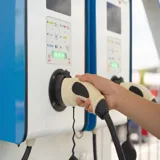
Emporia Smart Level 2 48A
Emporia
Best value smart charger on the market. 48A output with WiFi, energy monitoring, TOU scheduling, and solar integration. ENERGY STAR certified. Pairs with Emporia Vue for whole-home energy tracking.
Grizzl-E Classic 40A
Grizzl-E
The most durable home EV charger on the market. NEMA 4X aluminum enclosure rated from -30°F to 122°F. Adjustable amperage (16/24/32/40A). Designed and tested in Canada for extreme weather reliability.
EV Charger Rebates in Nearby States
Related Guides & Tools
Frequently Asked Questions
Why is Nebraska the only state with 100% public power?
How does the OPPD enhanced ($300) rebate tier differ from the baseline ($200) tier?
Does my address near Cooper Nuclear Station qualify for the federal 30C credit?
What does Nebraska's ice-storm risk mean for EV charger reliability?
Does LES offer EV charger rebates for Lincoln residents?
Can NPPD customers get an EV charger rebate?
Is the western Nebraska panhandle a viable place to install a home EV charger?
How does Nebraska wind generation affect overnight EV charging carbon profile?
CheapEVCharger Editorial Team
Independent EV charging editorial team. We compare home chargers based on manufacturer specifications, verified Amazon customer reviews, and real-time pricing data — never influenced by manufacturers.
Data sources: Product specifications from manufacturer websites, pricing and customer reviews from Amazon.com and Amazon.de, installation costs from industry reports, electricity rates from U.S. EIA and DOE.
Enjoyed this article?
Practical EV home-charging tips, honest charger picks, and NACS-transition updates — straight to your inbox.
No spam. Unsubscribe anytime.