
Best EV Charger for VW ID.4: Pro vs Standard, 11 kW vs 7.2 kW
The VW ID.4 you bought last week and the ID.4 your neighbor bought in 2022 do not charge at the same speed at home. The Pro and Pro S trims carry an 11 kW onboard charger (48 amps at 240V), while the original Standard and base RWD models cap at 7.2 kW (32 amps). VW has shuffled this spec across model years, and most of the “Best Charger for ID.4” advice on the internet quietly assumes the Pro number. Buying a $649 50-amp charger for a 32-amp car wastes $220 you could spend on a panel breaker upgrade or a longer conduit run.
This guide splits the recommendation by trim, walks through the rear-fender charge port quirks of the MEB platform, and flags two specific traps: the legacy We Charge subscription, and the 11 kW Pro’s 800V-architecture absence (which makes overnight Level 2 the practical home strategy, not DC fast charging in your driveway).
Prices, availability, and program terms are subject to change. Last verified: May 3, 2026. We strive for accuracy but recommend verifying details before purchase.
VW ID.4 Pro vs Standard: The Charger Spec That Changes Everything
VW has run the ID.4 in the US through three notable charging-spec configurations since launch. The pattern matters because picking a 48A charger for a 32A car is a $220 mistake that buys nothing — the onboard charger is the bottleneck either way. The cleanest rule: match charger amperage to onboard amperage, plus 25% headroom for NEC continuous-load compliance, and stop there.
| ID.4 Trim & Year | Onboard Charger | Max Amperage | Recommended EVSE |
|---|---|---|---|
| 2021–2022 RWD Standard | 7.2 kW | 32A | 32A charger on 40A breaker |
| 2021–2022 Pro / Pro S | 11 kW | 48A | 48A charger on 60A breaker |
| 2023+ RWD Standard | 11 kW | 48A | 48A charger on 60A breaker |
| 2023+ Pro / Pro S / S Plus | 11 kW | 48A | 48A charger on 60A breaker |
| 2024+ AWD trims (Pro AWD) | 11 kW | 48A | 48A charger on 60A breaker |
If you bought a 2021 or 2022 base RWD ID.4 with the smaller 62 kWh battery, your home charger sweet spot is 32 amps. A 32A unit on a 40A breaker is roughly $200 cheaper to install than a 48A unit on a 60A breaker because of wire-gauge differences (8 AWG vs 6 AWG copper) and breaker cost. Speed delta: a 32A charger adds about 20 miles of range per hour to that 62 kWh battery; a 48A charger you cannot use to its full potential adds the exact same 20 miles per hour.
For everything else — 2023+ ID.4s of any trim, including the long-debated Pro RWD configuration — the 11 kW onboard charger means a 48A EVSE is the right call. The 82 kWh battery (76 kWh usable) plus 11 kW onboard yields a 10–80% time of about 5.5 hours, which lands clean inside an overnight window even if you plug in at 11 PM. See our Level 1 vs Level 2 guide for the math behind why anything below 32A is a non-starter for the ID.4’s battery size.
MEB Platform Charging: ID.4 Shares Hardware With Audi Q4, ID.5, Skoda Enyaq
The Volkswagen Group rolled out the MEB (Modularer E-Antriebs-Baukasten) platform across a fleet of vehicles that all share the ID.4’s onboard charger architecture, charge port location, and J1772/CCS1 connector setup in the US market. If you cross-shopped or you’re moving between brands, the home charger you bought for one will work identically with the others.
- Audi Q4 e-tron / Q4 Sportback e-tron: Same 11 kW onboard charger on the equivalent trim, same rear-right charge port, same CCS1 fast-charge curve.
- VW ID.5 (Europe-only as of 2026): Identical electrical architecture. If you’re a US ID.4 owner, this matters only if you’re buying for a relative abroad.
- Skoda Enyaq iV: Same MEB chassis, same charging hardware spec; not sold in the US but worth knowing if you read European charging-speed comparisons.
- VW ID.7 sedan: 11 kW onboard charger as well, slightly larger 86 kWh battery.
Practical implication: any J1772 charger that works for an ID.4 Pro works identically for a Q4 e-tron 50. Two-EV households with one ID.4 Pro and one Q4 share the same 48A charger without compromise. The only differentiator at home is the cable reach — the Q4 is roughly 6 inches shorter than the ID.4, so cable routing in a single-car garage is marginally easier.
One MEB-specific gotcha: the AC charging curve on these vehicles is unusually flat. The ID.4 will hold near-peak 11 kW from 5% state of charge all the way to about 90%, only tapering in the final 10%. Compare that to the Tesla Model Y, which begins tapering AC charge speed earlier above 80%. For overnight charging this is invisible; for a 2-hour top-off before a dinner reservation, the ID.4 actually puts more kWh into the battery than a Model Y would in the same window.
No 800V Architecture: Why DC Fast Charging Is Slow (And Home Level 2 Is the Real Strategy)
The ID.4 runs a 400V battery architecture — the same voltage class as the Tesla Model 3, Ford Mustang Mach-E, Nissan Ariya, and Chevrolet Equinox EV. It does not run the 800V architecture pioneered in the Porsche Taycan and now used in the Hyundai Ioniq 5, Kia EV6, and Genesis GV60. That single voltage difference reshapes how owners use DC fast charging in the field, and it is why home Level 2 is the practical strategy for nearly all ID.4 driving.
DC Fast Charging Numbers (For Context)
The ID.4 Pro charges at a peak of 135 kW DC on a 350 kW Electrify America station, holding that peak only briefly before tapering aggressively. Real-world 10–80% on DC fast typically takes 30–38 minutes. Compare that to a Kia EV6 on the same station: peak 235 kW, holding above 200 kW for a meaningful chunk of the curve, 10–80% in roughly 18 minutes. The ID.4 is not slow on DC fast charging in absolute terms — it is just visibly slower than 800V peers, which the public station experience makes obvious.
Why This Pushes ID.4 Owners Toward Home Level 2
Two factors compound. First, Electrify America has had documented 800V-charger reliability issues that disproportionately affect 400V vehicles like the ID.4 because of the way the dispenser handles voltage matching. Second, even when the station works, the ID.4’s 38-minute typical session is long enough to require a real coffee-shop break, not a quick refuel. Result: most ID.4 owners use DC fast charging only on road trips and rely on overnight home Level 2 for 95% of energy delivered to the battery over a year. Our Level 1 vs Level 2 breakdown has the full math on why a properly-sized home charger covers the ID.4 use case completely.
The Three-Year VW We Charge Subscription
From 2021 through 2023, VW shipped new ID.4s with a three-year We Charge subscription (operated initially through Electrify America) that included free 30-minute fast-charge sessions. Many owners are now hitting subscription expiration in 2024–2026, which has pushed even more owners back to home charging as the default. If you bought a 2022 ID.4 and your free fast-charge ran out in early 2025, this article’s recommendations apply doubly — you are now paying for both fast charging on the road and home charging at home.
Rear-Right Charge Port: The Garage Layout Trap Specific to ID.4
The ID.4’s charge port lives on the rear-right (passenger-side) quarter panel, just behind the rear door. That is a less common location than the front-fender ports on Tesla, Ford, and Hyundai vehicles, and it changes how you should mount a Level 2 charger in a single-car or tight two-car garage.
Cable Reach Math With Rear-Mounted Port
The ID.4 is 180 inches long. If you back into a garage (which most owners do because the charge port is easier to reach), the port sits roughly 13 feet from the front of the parking position. If you pull in nose-first, the port sits about 6 inches from the back wall on most installs — which is where electrical panels typically live. A 23-foot ChargePoint Home Flex cable handles both orientations from a single side-wall mount; an 18-foot cable forces you to commit to one parking direction.
Body Angle & J1772 Connector Clearance
The ID.4’s rear quarter panel has a more pronounced body curve than a Tesla Model Y or Ford Mach-E. The J1772 connector seats squarely, but the cable approach angle matters: a charger mounted directly above and behind the port forces the cable into a tight bend that stresses the connector strain relief over thousands of plug cycles. Mount the charger at shoulder height (about 48–52 inches from the floor) on a side wall rather than on the back wall directly behind the car.
Two-Car Garage Sharing
If your second car is a Tesla Model Y with a left-rear NACS port, the ID.4’s right-rear J1772 port and the Tesla’s left-rear port are on opposite sides of a side-by-side parking layout. A single charger mounted on the dividing wall between the two parking positions can reach both vehicles, but you need a cable of at least 24 feet to manage the diagonal reach without the cable resting on either vehicle’s body. The Emporia 48A’s 24-foot cable was designed for exactly this scenario.
Outdoor Mounting If Your Garage Is Full
The ID.4 tolerates outdoor charging in heavy rain and snow without issue — the J1772 port is fully weathersealed when connected. The practical limitation outdoors is freezing-cold-weather range loss (Level 2 charging in sub-20°F temperatures with a battery that has cold-soaked overnight runs about 10% slower because the BMS pre-conditions the pack while charging). For Northeast and Midwest owners parking outside in winter, plan to plug in immediately after arrival to take advantage of residual battery heat.
Top 2 Chargers, Sized to Your ID.4 Trim
Pick 1: ChargePoint Home Flex — $649 (For Pro / 11 kW Trims)
Best for: 2023+ ID.4 owners and any Pro / Pro S trim with the 11 kW onboard charger.
The ChargePoint Home Flex at 50A output (12 kW) fully saturates the ID.4 Pro’s 11 kW onboard charger with no thermal headroom concerns even on hot Texas afternoons. The killer feature for ID.4 owners specifically is the adjustable amperage from 16A to 50A, which means if you buy now and later upgrade to a 2024+ ID.4 with the same 11 kW spec, the charger keeps working at full speed without electrical changes. The 23-foot cable reaches an ID.4’s rear-right charge port from most side-wall mounting positions.
The ChargePoint app is the only one in this price range that handles the ID.4’s slightly idiosyncratic AC charging curve well — energy reporting matches what the car logs in the VW app to within 1%. Time-of-use scheduling, push notifications when a session completes, and per-session cost estimates work cleanly with utility TOU rate plans where they exist.
- Price: $649
- Max amperage: 50A (12 kW), adjustable down to 16A
- Connector: J1772
- Cable length: 23 ft
- WiFi: Yes
- Circuit required: 60A double-pole breaker, 6 AWG copper wire for full 50A; can be dialed down to 32A on a 40A breaker
Pick 2: Emporia Smart Level 2 48A — $429 (Best Value for 11 kW Trims)
Best for: ID.4 Pro owners who want full speed with energy monitoring at the lowest fair price.
The Emporia Smart 48A delivers 11.5 kW — just enough headroom over the ID.4 Pro’s 11 kW spec to deliver maximum charge speed. The 24-foot cable is the longest in this segment and is genuinely useful for the ID.4’s rear-right port location. The built-in energy monitoring with solar integration is a real feature, not a marketing bullet: it tracks per-session energy delivered, exports the data to Emporia’s cloud, and integrates with home solar inverter data if you have rooftop PV.
For the $220 saved over the ChargePoint, you give up a slightly more polished app interface and the brand-name network of public ChargePoint stations (which the home unit talks to but does not actually share infrastructure with). For ID.4 owners who do not also want to use ChargePoint’s public network frequently, that trade-off is straightforward.
- Price: $429
- Max amperage: 48A (11.5 kW)
- Connector: J1772
- Cable length: 24 ft
- WiFi: Yes
- Circuit required: 60A double-pole breaker, 6 AWG copper
If You Have a 7.2 kW Trim (2021–2022 RWD Standard)
Skip both 48A picks. A 32A unit like the Grizzl-E Classic at $300 matches your onboard charger’s 32A ceiling exactly. You will see no real-world speed difference vs a 48A charger because the car simply will not draw more than 32 amps. The savings on hardware ($129–$349) plus reduced installation cost (40A breaker, 8 AWG wire vs 60A breaker, 6 AWG wire) typically totals $400–$600.
VW We Charge: What It Was, Why It Ended, What Replaced It
VW launched the We Charge subscription program alongside the original ID.4 in 2021 as a Volkswagen-branded membership for the Electrify America network — convenient because Electrify America was VW Group-owned at the time. The structure of the program shaped a lot of early ID.4 ownership patterns and still affects how owners think about home charging today.
Original Three-Tier Structure (2021–2023)
- We Charge Free: No monthly fee, pay-per-session pricing at Electrify America stations.
- We Charge Plus: $4/month for reduced per-kWh rates and idle-fee mitigation.
- We Charge Pro: $7/month for the lowest per-kWh rate plus priority routing in the VW navigation system.
New 2021–2023 ID.4 owners also received three years of free 30-minute Electrify America fast-charge sessions bundled with the vehicle purchase. That benefit set an expectation that fast charging would be free or near-free, which made early adopters less concerned about home charger speed. The benefit expired three years from the vehicle’s in-service date, which means most 2021 ID.4 owners hit expiration in 2024 and most 2022 owners are hitting expiration this year.
What Replaced We Charge
VW restructured the program for 2024+ ID.4s into a simpler arrangement: new buyers receive 500 kWh of free Electrify America DC fast charging (roughly 1,800 miles of range) credited over three years, after which standard Electrify America Pass+ pricing applies. The simpler structure pushed more owners toward home charging as the default mode of energy delivery from day one, rather than the “use up the free fast charging first” pattern that earlier We Charge fostered.
Practical implication for charger selection: if you bought your ID.4 in 2021–2023 and your free fast-charge benefit just expired, your average cost-per-mile for fast charging just jumped from $0.00 to roughly $0.16/mile (at $0.43/kWh average Electrify America rates). Home charging at $0.16/kWh works out to roughly $0.04/mile for the ID.4, a 4× cost reduction. A $429 Emporia pays for itself in roughly 11,000 miles of avoided fast-charging.
Installation: Circuit Sizing, Wire Gauge, Permit Reality
The ID.4 uses a standard J1772 connector for Level 2, so installation is straightforward in mechanical terms. The variables are circuit sizing (which depends on your trim), permit jurisdiction, and panel capacity.
- Circuit breaker for 48A trims (Pro / 2023+): 60-amp double-pole breaker on a dedicated 240V circuit with 6 AWG copper wire. NEC requires the 125% continuous-load rule, which is why a 48A continuous load needs a 60A breaker, not a 50A.
- Circuit breaker for 32A trims (2021–2022 RWD base): 40-amp double-pole breaker with 8 AWG copper wire. About $200–$400 cheaper to install than the 60A version because of the smaller wire and breaker cost.
- Panel capacity check: A 200-amp service panel handles a 60A EV charger circuit comfortably. A 100-amp service panel often cannot — you may need a panel upgrade or a load-management device. Our panel upgrade guide covers when this is necessary.
- Outdoor mounting: Both recommended chargers are NEMA 3R rated, which is fine for direct rain exposure on a vertical wall. For Texas, Arizona, or Florida installs in direct sun on a south or west wall, look for NEMA 4X (the Grizzl-E Classic is the budget option here, the ChargePoint Home Flex meets NEMA 3R, which is borderline in extreme heat).
- Hardwired vs plug-in: Hardwired installation is recommended for 48A units because NEC 625.42 limits NEMA 14-50 outlet-fed chargers to 40A continuous output (50A breaker, 80% derating). Hardwired removes that ceiling, lets the 48A units run at their full rated output, and is required by some utility rebate programs.
- Permit reality: Major US metros require an electrical permit ($60–$180 typical), and the inspection signs off the breaker, conduit, and grounding. Skipping the permit voids most home insurance coverage of the install. See our installation cost breakdown for jurisdiction-by-jurisdiction details.
- Professional labor: Budget $400–$800 for a licensed electrician, more if your panel is on a separate floor from the garage, your house has a finished basement that complicates wire routing, or your jurisdiction requires conduit (most do).
The ID.4’s rear-mounted port also nudges you toward a hardwired install — a NEMA 14-50 outlet positioned to feed a plug-in charger with a typical 18-inch pigtail will end up either too far from the rear of the parking spot or too close to the side wall. A hardwired unit mounted on the side wall at shoulder height with a 23–24 foot cable handles the geometry cleanly.
ID.4 Charging Cost: 82 kWh Battery Math
Here is what it costs to charge a VW ID.4 Pro at home based on the US average residential electricity rate of $0.16/kWh:
| Scenario | kWh Used | Monthly Cost |
|---|---|---|
| Average driver (1,000 mi/month, 30 kWh/100mi) | 300 kWh | $48 |
| Heavy driver (1,500 mi/month) | 450 kWh | $72 |
| Light driver (500 mi/month) | 150 kWh | $24 |
| Full charge (0–100%, 82 kWh battery) | 82 kWh + 10% AC charge loss | ~$14.43 |
| 10–80% top-up (typical home charge) | 57 kWh + loss | ~$10.03 |
The ID.4 consumes about 30 kWh per 100 miles in EPA combined cycle testing, which is at the higher end of the compact electric SUV segment (the Tesla Model Y is closer to 26 kWh/100mi, the Ioniq 5 is around 28 kWh/100mi). The ID.4’s heat pump (standard from 2023 onward, optional before that) cuts winter energy use by 10–15% vs the resistive-heat-only earlier trims — the difference shows up most clearly in the December–February monthly bill.
If your utility offers a time-of-use rate with super-off-peak pricing (typical band: 11 PM–6 AM at $0.08–$0.10/kWh), charging exclusively in that window cuts the average driver’s monthly bill from $48 to roughly $24–$30. Both recommended chargers support TOU scheduling. The ID.4’s in-car schedule also works for this, though the EVSE-side schedule is more reliable in practice because it does not depend on the car’s 12V battery state during a long park.
For your specific rate and driving pattern, run the numbers in our EV Charging Cost Calculator.
VW Software Updates & How They Changed ID.4 Home Charging Behavior
The ID.4 has been one of the more software-update-heavy EVs in the US market since 2021. Volkswagen has pushed roughly 8 major over-the-air updates that touched charging behavior in some way, and the cumulative effect is that an early-build 2021 ID.4 charges noticeably differently today than it did at delivery. Owners shopping for a home charger should know which behaviors are firmware-driven (and therefore subject to change) and which are hardware-fixed.
The 2.5 Update (Late 2022): The Big One
Volkswagen pushed the 2.5 software update to 2021–2022 ID.4s in late 2022. It rewrote the AC charging routine to better handle 48A continuous draw, fixed a documented thermal-management bug that occasionally throttled the onboard charger to 7.7 kW (32A) on hot summer afternoons, and added a rate-of-charge selector to the in-car interface. Pre-2.5 owners often saw inconsistent charge times that improved dramatically post-update. If you bought a used 2021 or 2022 ID.4 and it appears to charge slowly, verify the software version is at least 2.5 (typically 3.0 or 3.1 by 2026 on properly-updated cars).
The 3.0 Update (2023): Charge Limits and Departure Preconditioning
Volkswagen 3.0 added in-car charge limit settings (50%, 60%, 70%, 80%, 90%, 100%) and scheduled departure preconditioning that uses wall power to warm or cool the cabin from a plugged-in car. Before 3.0, ID.4 owners had to set charge limits via the EVSE-side schedule (the home charger’s app), which was less reliable because the EVSE does not know your departure time, only the schedule window. Post-3.0, the in-car schedule is the better tool for charge limits and the EVSE schedule handles only off-peak window enforcement.
The 3.1 Update (2024): Plug & Charge Refinements
Volkswagen 3.1 added Plug & Charge support for Electrify America stations — the car authenticates over the J1772 / CCS1 protocol and the session bills automatically without the owner tapping a card or scanning a QR code. This is a public DC fast charging feature only; home Level 2 charging on a J1772 EVSE never required this kind of authentication. Plug & Charge is irrelevant to your home charger choice but worth knowing if you read forum threads from 2022 ID.4 owners describing payment friction at public stations.
What These Updates Did Not Change
The hardware specs are fixed: 11 kW onboard charger on Pro trims and 2023+ all trims, 7.2 kW onboard charger on 2021–2022 base RWD. No software update has changed the maximum amperage the car can draw from a J1772 charger. The thermal management improvements in 2.5 and later updates make the car more consistently hit its 48A ceiling under hot or cold conditions, but they do not raise the ceiling itself.
Implication for Charger Selection
If you are shopping a used 2021 or 2022 ID.4, verify the seller has applied the post-2.5 updates before negotiating on price. A pre-2.5 ID.4 will appear to have charging issues that are firmware-fixed in any properly-updated unit. For new 2024+ ID.4s, the software is current at delivery and your home charger choice depends only on trim (48A for all current US trims). Volkswagen’s OTA cadence for the ID.4 has slowed from 2022 to 2026 as the platform matures, so dramatic charging behavior changes from future updates are less likely than they were in the early ownership years.
The MyVW App vs Your EVSE App: Same Pattern as Other EVs
Like every EV in this article, the ID.4 runs a two-app charging workflow at home. The MyVW app handles in-car settings (charge limit, departure preconditioning, climate start). The home EVSE app (ChargePoint or Emporia) handles per-session kWh tracking, dollar cost estimation, and monthly summary reporting. The two apps coexist because the underlying J1772 protocol does not depend on either — whichever signals stop first wins, and that is almost always the in-car charge limit.
Federal 30C Tax Credit: 58 Days Until the June 30, 2026 Deadline
The Section 30C Alternative Fuel Vehicle Refueling Property tax credit covers 30% of EV charger purchase and installation costs, up to $1,000 for residential installs. The current authorization is set to expire on June 30, 2026 — about 58 days from this article’s last update. Installations must be placed in service by that date to qualify under current law.
What Counts as Qualifying Cost
- The EV charger hardware (the $429 Emporia or $649 ChargePoint).
- Licensed electrician labor for installation.
- The dedicated 240V circuit, breaker, and wire.
- Conduit, weatherproof enclosures, and any permits or inspection fees.
- If your install requires a panel upgrade specifically for the EV charger, that cost is partially eligible — check Form 8911 instructions for the allocation method.
Census Tract Eligibility
Section 30C only applies to installations in qualifying census tracts — either rural or designated low-income or energy-community tracts. Roughly 60% of US land area qualifies, but most major metro cores do not. The IRS publishes an eligibility lookup tool — run your installation address through it before assuming the credit applies. ID.4 buyer demographics skew suburban, where the credit applies more often than not, but Houston Heights, Austin downtown, Brooklyn, San Francisco, and Boston cores typically do not qualify.
How to Claim
File IRS Form 8911 with your federal tax return for the year of installation. The credit is non-refundable, which means it offsets tax liability but does not generate a refund beyond zero owed. For most ID.4 buyer demographics (household income $80K+), there is enough liability to absorb the full $1,000 credit. Our 30C walkthrough covers the form line-by-line.
Stack With Utility Rebates
The 30C credit is calculated on net cost after utility rebates. If you have a $1,229 install (Emporia + $800 labor) and your utility rebates $1,200, your federal credit is calculated on the $29 net — a $9 credit, not $369. This is the rule that catches Austin Energy, BGE, Eversource, and Xcel customers who were planning to double-dip. For state-by-state rebate stacking math, see our EV charger rebates hub.
If you live in a non-qualifying census tract, the federal credit is zero and the entire savings story comes from utility rebates plus TOU electricity rates — which for an ID.4 owner driving 12,000 miles/year still totals $300–$700 in first-year savings.
State and Utility Stacking for ID.4 Buyer Demographics
ID.4 sales concentrate in suburban metros across California, Texas, Florida, the Northeast, and the Pacific Northwest — markets where state and utility rebates often layer cleanly on top of the federal 30C credit. California has no direct hardware rebate but offers EV-specific TOU rate plans through PG&E (EV2-A) and SCE (EV-TOU-5) that cut overnight charging cost by 40–55%. Texas Austin Energy customers can access the EV360 rebate up to $1,200 (see our Texas EV charger rebates page); CPS Energy offers up to $500 in San Antonio; Oncor offers up to $250 in DFW. Massachusetts MassEVIP covers up to $700 in eligible municipalities. New York NYSERDA Charge Ready NY covers up to $500 in qualifying ZIP codes.
The order of operations matters: get utility rebate quotes first, then estimate the federal credit on net cost after rebates. ID.4 owners in Austin Energy territory routinely run cash-positive on a $1,229 install (Emporia 48A + $800 labor) after the EV360 rebate and the 30C credit on the small remaining balance. Run your specific scenario through our EV charger rebates hub for state-by-state stacking math.
Recommended Products
As an Amazon Associate, we earn from qualifying purchases at no extra cost to you. Learn more
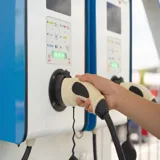
ChargePoint Home Flex
ChargePoint
The most recognized name in EV charging. 50A output (highest residential charger), adjustable 16-50A, NEMA 3R outdoor rated. Industry-leading app with Alexa/Google integration and utility-approved for managed charging programs.
Emporia Smart Level 2 48A
Emporia
Best value smart charger on the market. 48A output with WiFi, energy monitoring, TOU scheduling, and solar integration. ENERGY STAR certified. Pairs with Emporia Vue for whole-home energy tracking.
Related Articles & Tools
Frequently Asked Questions
Does my 2022 VW ID.4 have an 11 kW or 7.2 kW onboard charger?
Do I need a 48A charger for a 2021 VW ID.4 base RWD?
How long does it take to charge a VW ID.4 Pro from 10% to 80% on a 48A home charger?
Can a VW ID.4 charge faster on DC fast charging than on home Level 2?
Where is the charge port on a VW ID.4?
Did VW We Charge include free home charging?
What size circuit breaker do I need for a VW ID.4 Pro charger?
Does the VW ID.4 work with the Tesla Wall Connector?
CheapEVCharger Editorial Team
Independent EV charging editorial team. We compare home chargers based on manufacturer specifications, verified Amazon customer reviews, and real-time pricing data — never influenced by manufacturers.
Data sources: Product specifications from manufacturer websites, pricing and customer reviews from Amazon.com and Amazon.de, installation costs from industry reports, electricity rates from U.S. EIA and DOE.
Enjoyed this article?
Practical EV home-charging tips, honest charger picks, and NACS-transition updates — straight to your inbox.
No spam. Unsubscribe anytime.