
How to Charge an EV in an Apartment Without a Garage
Living in an apartment doesn't mean you can't own an electric vehicle — but it does mean you need a charging strategy. Over 30% of Americans rent, and the lack of home charging is the #1 barrier to EV adoption for apartment dwellers. Here are five real solutions that work in 2026, plus tips for talking to your landlord and leveraging new right-to-charge laws.
Prices, availability, and program terms are subject to change. Last verified: March 15, 2026. We strive for accuracy but recommend verifying details before purchase.
The Apartment EV Charging Challenge
Let's acknowledge the elephant in the room: apartment EV charging is harder than house EV charging. When you own a house with a garage, you install a Level 2 charger, plug in every night, and wake up with a full battery. Easy. When you live in an apartment, you face a unique set of obstacles:
- No dedicated parking with electrical access — Most apartment parking spots (surface lots, street parking) don't have outlets anywhere nearby.
- Landlord approval required — Even if you have a garage or assigned spot, installing an outlet or charger typically requires the property owner's permission.
- Shared electrical infrastructure — Apartment buildings have shared electrical panels and metered systems. Who pays for the electricity? How is it billed? These questions stop many building managers in their tracks.
- Lease restrictions — Some leases prohibit modifications to the property, including electrical work.
- No guarantee of the same spot — If you don't have an assigned parking space, a charger installation doesn't make sense.
Despite these challenges, millions of apartment dwellers successfully own EVs. The solutions range from portable chargers you can use with any standard outlet, to workplace charging, to public charging networks that have expanded dramatically. According to the Department of Energy, the U.S. now has over 180,000 public charging ports — nearly triple the number from just five years ago.
The key is having a multi-pronged strategy rather than relying on a single charging solution. Let's walk through every option available to you.
5 Ways to Charge Your EV Without a Garage
Here are the five most practical ways apartment residents charge their EVs in 2026, ranked from most to least convenient.
1. Portable Level 2 Charger + Existing Outlet
This is the most underrated solution for apartment EV owners. Many apartments have 120V outlets in garages, carports, or near parking areas — for engine block heaters, vacuums, or lighting. A portable EV charger can plug into these outlets and deliver Level 1 charging (3–5 miles of range per hour) overnight.
But here's the real upgrade: some apartments — especially those with in-unit washers/dryers — have 240V outlets (NEMA 14-30 or 14-50) that you may be able to access. A portable Level 2 charger like the Lectron Portable ($249) works on both 120V and 240V, giving you up to 25 miles of range per hour on a 240V outlet.
The beauty of a portable charger is that it's your property — you take it with you when you move. No permanent installation, no landlord approval needed for the charger itself (though you should get permission to use building outlets for extended charging). When you're not charging, it fits in your trunk. Check our portable EV charger reviews for our top picks.
2. Workplace Charging
Workplace charging is booming. An increasing number of employers offer free or subsidized EV charging as an employee benefit. If your workplace has Level 2 chargers, you can add 100–200 miles of range during an 8-hour work day — more than enough for most drivers.
Even if your employer doesn't currently offer charging, it's worth asking. Many companies are adding chargers to attract and retain employees, and federal tax credits make it financially attractive for businesses. The IRS offers businesses a 30% tax credit (up to $100,000) for installing commercial EV charging infrastructure.
If workplace charging is your primary strategy, you really only need to "top off" on days you don't go to the office, which can be handled with a portable charger or occasional public charging session.
3. Public Charging Networks
Public charging has matured enormously. In most urban and suburban areas, you're never more than a few miles from a public charger. The major networks include:
- Tesla Supercharger Network — Now open to non-Tesla EVs at many locations. DC fast charging: 15–30 minutes for 80%.
- ChargePoint — The largest Level 2 network. Many locations are free (shopping centers, hotels).
- Electrify America — DC fast charging network with stations along major highways and in urban areas.
- EVgo — Urban-focused fast charging, often located at grocery stores and malls.
- Blink, FLO, and others — Growing networks with mixed Level 2 and DC fast options.
The cost of public charging varies: Level 2 is often free or $1–$3/hour, while DC fast charging runs $0.30–$0.50/kWh. Use our Charging Cost Calculator to compare public vs. home charging costs for your situation.
4. Request Building-Wide EV Charging
This is a longer-term play, but it's increasingly successful. Many apartment complexes are installing shared EV charging stations as amenities, similar to fitness centers and package lockers. If your building doesn't have them yet, you can be the catalyst.
Approach your property management with a business case (see our landlord script in the next section). Key selling points: EV charging amenities increase property value, attract higher-quality tenants, and may qualify for federal and state tax credits and rebates. Companies like ChargePoint, Blink, and EverCharge specialize in multi-unit dwelling installations and often offer revenue-sharing models that cost the property owner nothing upfront.
5. Nearby Charging at Businesses You Already Visit
This is the "lifestyle integration" approach — instead of making special trips to charge, you charge where you already spend time:
- Grocery stores: Many Whole Foods, Walmart, Target, and Kroger locations have free Level 2 chargers. A 1-hour shopping trip adds 25–30 miles.
- Gyms: Some gym chains (LA Fitness, Equinox) offer EV charging.
- Movie theaters and restaurants: A 2-hour dinner adds 50–60 miles on Level 2.
- Libraries and community centers: Increasingly common, and usually free.
The math works: if you average 37 miles per day (the national average), two or three opportunistic charging sessions per week can keep your battery comfortably full. Use our Charging Time Calculator to see exactly how much range you'll gain at each stop.
Talking to Your Landlord: A Script That Works
Asking your landlord to install EV charging — or even just to let you use an existing outlet — can feel awkward. But framing it correctly makes a huge difference. Here's a proven approach that addresses their concerns before they raise them.
The Email Template
Adapt this to your situation:
Subject: EV Charging Request — Minimal Cost, Property Value Benefit
Hi [Property Manager/Landlord Name],
I recently purchased an electric vehicle and I'm reaching out about EV charging options at [apartment name]. I'd like to propose a solution that's simple, low-cost, and actually increases the property's value and appeal to future tenants.
Option A (Simplest): Allow me to use an existing 120V outlet near my parking spot for overnight charging with my own portable charger. I'm happy to pay a flat monthly fee for electricity ($20–$30 covers the typical cost) or have it metered.
Option B (Small upgrade): Allow me to hire a licensed electrician at my expense to install a dedicated 240V outlet at my assigned parking spot. The outlet stays with the property when I leave — it's an improvement that benefits future tenants.
Option C (Best long-term): Consider partnering with an EV charging company like ChargePoint or EverCharge to install shared charging stations. Many of these companies cover the hardware cost entirely through revenue-sharing models, and there are federal tax credits that cover 30% of installation costs. EV charging is increasingly expected by renters — 40%+ of new car buyers are considering an EV for their next purchase.
I'm happy to discuss any of these options. I've done the research and can share information about costs, rebates, and installation logistics.
Thank you,
[Your Name]
Addressing Common Landlord Objections
Be prepared for these pushbacks:
"It's too expensive."
A single 240V outlet costs $300–$600 to install. Under Option A, the cost is $0 — you're using an existing outlet. Under Option B, you're paying for the installation yourself. For Option C, third-party companies often cover hardware and installation costs entirely. The federal 30C tax credit covers 30% of costs up to $100,000 for commercial properties.
"Who pays for the electricity?"
Offer a flat monthly fee ($20–$40 covers typical use) or suggest a metered charger that bills you directly. Networked chargers from ChargePoint and others can track usage per user and bill accordingly — the landlord never handles the billing. You can show them the math using our Charging Cost Calculator.
"What about liability?"
Licensed electrician installation with permits and inspection eliminates liability concerns — the work meets building code. UL-listed EV chargers have extensive safety certifications. Many charger companies carry their own insurance as well. The liability of a code-compliant EV charger installation is no different from any other permitted electrical work.
"Other tenants will want one too."
That's actually the point — it's a desirable amenity. Present it as a feature that increases property value and tenant retention. Studies show that properties with EV charging command 2–5% higher rents and have lower vacancy rates.
"Our electrical panel can't handle it."
A Level 2 charger draws 30–40 amps — similar to one apartment unit's dryer. Smart chargers with load management can limit draw during peak hours. An electrician can assess capacity and recommend solutions, including sub-panels or load management devices. Read our installation cost guide for full details on panel considerations.
Public Charging Strategy for Apartment Dwellers
If home charging isn't possible right now, public charging can absolutely work as your primary strategy — but you need to be intentional about it. Here's how to build a reliable public charging routine.
Map Your Charging Options
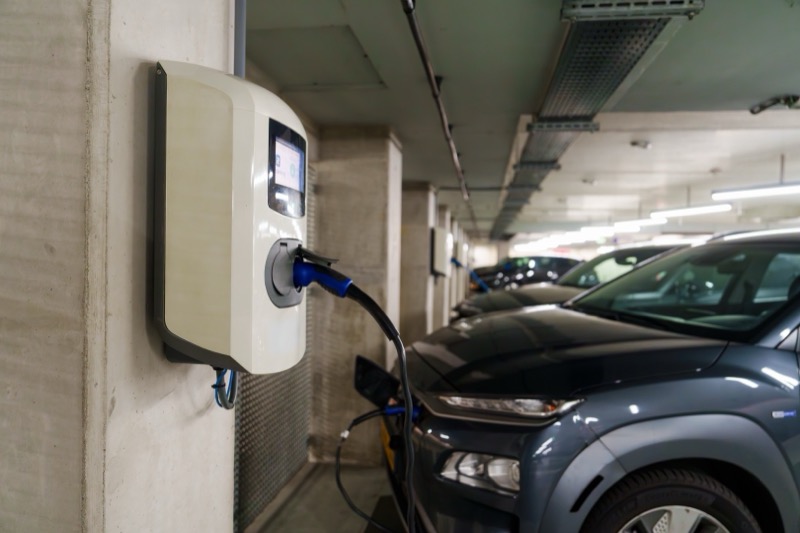
Before you even buy an EV, map every public charger within a 5-mile radius of your apartment. Use PlugShare (the most comprehensive database) and your EV's built-in navigation. Pay attention to:
- Charger types: Level 2 (slow but cheap/free) vs. DC fast charging (fast but pricier)
- Availability: Check PlugShare reviews for reliability and wait times. Avoid chargers with frequent "broken" reports.
- Cost: Some are free (hotels, shopping centers, municipal lots). Paid Level 2 runs $1–$3/hour. DC fast charging costs $0.30–$0.50/kWh.
- Hours: Some chargers have time limits or are only accessible during business hours.
- Proximity to your routine: Chargers near your grocery store, gym, or workplace are gold.
The Weekly Charging Plan
For an average driver (37 miles/day, ~260 miles/week), here's a sustainable public charging plan:
- Primary: One 2-hour Level 2 session while grocery shopping (2x/week) = ~120 miles
- Secondary: One 30-minute DC fast charging session per week = ~150 miles
- Backup: Workplace Level 2 on days you drive to the office = ~100 miles per day
Total: 370+ miles per week from incidental charging — no special trips needed. The key is to charge opportunistically (while doing things you'd do anyway) rather than making dedicated charging trips.
Cost Comparison: Public vs. Home Charging
Public charging costs more than home charging, but the gap is narrower than you might think:
| Charging Method | Cost per kWh | Monthly Cost (1,000 mi) |
|---|---|---|
| Home Level 2 (national avg) | $0.13/kWh | $39 |
| Public Level 2 (paid) | $0.15–$0.25/kWh | $45–$75 |
| Public Level 2 (free) | $0.00/kWh | $0 |
| DC Fast Charging | $0.35–$0.50/kWh | $105–$150 |
| Gasoline (for comparison) | N/A | $130–$200 |
Even using paid public Level 2 chargers exclusively, you're still saving money compared to gasoline. Mix in some free Level 2 and the savings are substantial. Use our EV vs Gas Savings Calculator to see your personal savings based on your driving habits.
Pro Tips for Public Charging
- Get multiple network apps: Install ChargePoint, Electrify America, EVgo, and Tesla (if applicable) on your phone. Each network has exclusive stations.
- Set charging reminders: Don't wait until you're at 10%. Charge when convenient, not when desperate.
- Avoid peak times: Weekday evenings and weekend afternoons are busiest at public chargers. Early mornings and late evenings are usually wide open.
- Sign up for memberships: Most networks offer subscriptions ($4–$10/month) that reduce per-kWh rates by 20–30%.
Best Portable Chargers for Apartments
A portable EV charger is arguably the single best investment for apartment EV owners. Unlike wall-mounted chargers that require permanent installation, portable chargers go where you go. Here's what to look for and our top picks.
What Makes a Good Apartment Charger
- Dual-voltage (120V/240V): Works with any outlet you have access to — standard 120V household outlets or 240V outlets if available.
- Long cable (20+ feet): Apartment parking situations often mean longer distances between outlet and car. A long cable eliminates the temptation to use an extension cord (which is dangerous and not recommended).
- Compact and lightweight: You may need to carry it from your apartment to the parking area daily.
- Multiple plug adapters: NEMA 5-15 (standard), 14-50, 14-30, 6-20 — the more options, the more outlets you can use.
- Weather resistance: If you're charging in an outdoor parking spot, the charger needs to handle rain and temperature extremes.
Our Top Picks for Apartment Living
Best Budget: The Emporia Smart ($159) is the cheapest Level 2 charger on the market. While it's technically a wall-mount unit, it can be used portably with a NEMA 14-50 outlet if you have access to one. It offers 48A charging, WiFi scheduling, and a 24-foot cable. See our full review in the best chargers under $300 roundup.
Best Portable: The Lectron Portable ($249) is purpose-built for portability. It works on both 120V and 240V outlets, includes a 21-foot cable, and fits easily in your trunk. At 120V you get Level 1 speeds (3–5 mi/hr), but plug into a 240V outlet and you jump to 25+ mi/hr.
Best for Outdoor Spots: The BougeRV Portable ($279) is built for all-weather use with an IP66 waterproof rating. It handles temperatures from -22°F to 122°F, making it ideal for uncovered parking spots. Dual-voltage compatible with a 25-foot cable.
How to Use a Portable Charger in an Apartment
- Identify available outlets: Walk your apartment's parking area and note every outlet. Check garages, carports, shared utility rooms, and exterior walls. Don't forget laundry rooms (many have 240V dryer outlets).
- Get permission: Ask your landlord or property manager if you can use a specific outlet for EV charging. Offer to pay for electricity (see our landlord script above).
- Test the outlet: Make sure it's on a dedicated circuit (not shared with critical building systems). Use a circuit tester ($10 at any hardware store) to verify proper grounding.
- Set a charging schedule: If using a shared outlet, charge during off-peak hours (10 PM – 6 AM) to minimize impact on other residents.
- Secure your equipment: Use a cable lock ($15–$25) to prevent theft of your portable charger while it's charging overnight.
Browse our complete portable EV charger guide for detailed reviews and comparisons.
The Future: Right-to-Charge Laws
Here's the exciting news for apartment EV owners: right-to-charge laws are spreading across the country, and they're changing the game for renters and condo owners.
What Are Right-to-Charge Laws?
Right-to-charge laws prevent landlords, HOAs, and condo associations from unreasonably prohibiting EV charging installations. They give tenants and unit owners the legal right to install EV charging equipment, even if the property owner or association would prefer to say no.
These laws vary by state but generally establish that:
- A landlord or HOA cannot outright ban EV charger installation
- The EV owner typically pays for installation and electricity
- The installation must be done by a licensed electrician and meet code
- The property owner can set reasonable conditions (insurance, restoration upon move-out)
- Any restrictions must be "reasonable" and cannot effectively prevent charging
States with Right-to-Charge Laws (2026)
As of early 2026, the following states have enacted right-to-charge legislation:
- California (SB 880): The strongest law. Landlords and HOAs cannot prohibit EV charging installation. Covers both renters and condo owners. Also requires new multi-family construction to include EV charging infrastructure (CALGreen).
- Colorado (HB 23-1233): Tenants can install EV charging at assigned parking spaces. Landlord can require licensed installation and insurance.
- Florida (SB 520): Condo associations cannot prohibit EV charging. The unit owner pays all costs.
- Oregon (SB 1044): Landlords cannot unreasonably deny EV charging requests from tenants with assigned parking.
- Virginia, Maryland, New York, New Jersey, Illinois: Various provisions protecting EV charging rights in multi-unit dwellings.
- Washington, Connecticut, Massachusetts: Right-to-charge laws with varying scope and requirements.
Check your state's specific legislation, as details and requirements vary. The U.S. Department of Energy maintains an updated database of state EV policies.
What's Coming Next
The trend is unmistakable: right-to-charge laws will become the national standard within the next few years. As EV adoption accelerates (EVs now represent over 25% of new car sales), the political pressure to ensure charging access for renters and condo owners will only grow.
Several developments to watch:
- Federal right-to-charge legislation: Bills have been introduced in Congress to establish a national baseline. While passage timing is uncertain, the direction is clear.
- Building code updates: The 2024 International Building Code (IBC) recommends EV-ready infrastructure in new multi-family construction. Jurisdictions adopting this code will require wiring for EV charging in new apartment buildings.
- Utility programs: Major utilities are partnering with apartment complexes to install shared charging infrastructure at reduced cost, funded by ratepayer programs approved by public utility commissions.
- Employer pressure: Large employers are increasingly requiring or incentivizing EV charging at employee housing, particularly in company towns and near major employment centers.
What You Can Do Now
While waiting for broader legal protections:
- Know your state's current law — you may already have the right to charge.
- Document everything — if your landlord denies a charging request, get it in writing. This may be relevant if right-to-charge laws are retroactive in your state.
- Contact your state representative — right-to-charge bills need constituent support to move forward.
- Join local EV owner groups — collective advocacy is more effective. Many apartment-based EV owners have successfully negotiated charging access through organized tenant efforts.
- Use portable solutions in the meantime — a portable EV charger gives you flexibility regardless of your building's policies.
Living in an apartment and driving an EV is already practical in 2026 — and it's only going to get easier. Whether you use a portable charger, public networks, workplace charging, or convince your landlord to install dedicated stations, the solutions exist. Start with the approach that works for your situation today, and know that the infrastructure and legal landscape are moving in your favor.
Recommended Products
As an Amazon Associate, we earn from qualifying purchases at no extra cost to you. Learn more
BougeRV Smart Level 2 48A
BougeRV
Budget smart charger with WiFi and app control at an aggressive price point. 48A output, NEMA 14-50 plug, and Bluetooth fallback for reliable connectivity.
ChargePoint Home Flex
ChargePoint
The most recognized name in EV charging. 50A output (highest residential charger), adjustable 16-50A, NEMA 3R outdoor rated. Industry-leading app with Alexa/Google integration and utility-approved for managed charging programs.
Related Articles & Tools
Frequently Asked Questions
Can I charge an EV if I live in an apartment?
Yes. Apartment EV owners have five main options: 1) Use a portable EV charger with an existing outlet near your parking spot. 2) Charge at work if your employer offers EV charging. 3) Use public charging networks (ChargePoint, Electrify America, Tesla Superchargers). 4) Request that your building install shared EV charging. 5) Charge at businesses you already visit (grocery stores, gyms). Most apartment EV owners use a combination of these methods.
Can my landlord refuse to let me install an EV charger?
It depends on your state. States like California, Colorado, Florida, and Oregon have right-to-charge laws that prevent landlords from unreasonably denying EV charger installation. In other states, landlords can legally refuse. However, even without legal requirements, many landlords agree when presented with a good business case — EV charging increases property value and attracts tenants. See our landlord script above, and check installation costs to present accurate numbers.
What is the cheapest way to charge an EV in an apartment?
The cheapest option is free public Level 2 charging at shopping centers, libraries, and municipal lots — many locations offer this. Second cheapest is using a portable charger with an existing outlet at your apartment (Level 1 costs about $0.04–$0.05/mile). Third is paid public Level 2 at $0.15–$0.25/kWh. Even the most expensive option — DC fast charging at $0.35–$0.50/kWh — is still cheaper than gasoline. Use our EV vs Gas Savings Calculator to see your personal savings.
Is a portable EV charger good enough for apartment living?
Absolutely. A portable charger is often the best solution for apartment residents. On a standard 120V outlet, you get Level 1 charging (3–5 miles/hour — about 40 miles overnight). On a 240V outlet, you get Level 2 speeds (25+ miles/hour). Top picks include the Lectron Portable ($249) and BougeRV ($279), both with dual-voltage capability and 20+ foot cables. See our complete portable charger guide and budget options under $300.
How much does it cost to charge an EV using public chargers only?
For 1,000 miles per month of driving: Free Level 2 chargers cost $0. Paid Level 2 runs $45–$75/month. DC fast charging costs $105–$150/month. A mix of free and paid Level 2 with occasional fast charging typically runs $40–$80/month — still far less than the $130–$200/month most people spend on gasoline. Use our Charging Cost Calculator to estimate costs based on your specific driving patterns and local rates.
What are right-to-charge laws?
Right-to-charge laws prevent landlords and HOAs from unreasonably denying EV charger installations. As of 2026, states including California, Colorado, Florida, New York, Oregon, and Virginia have enacted these laws. They typically require the tenant to cover installation costs and liability insurance. Even in states without these laws, many landlords agree when presented with data showing chargers increase property value by $5,000-$15,000.
Can I charge my EV from a regular outlet in my apartment parking garage?
Only with landlord permission and if the outlet is on a circuit that can handle continuous 12A draw (a standard 15A or 20A circuit). Level 1 charging from a 120V outlet adds 3-5 miles of range per hour — about 40 miles overnight. This is often sufficient for daily commutes under 30 miles. Never plug into an outlet without permission, as the electricity cost and circuit load are the building's responsibility.
Are there apps to help apartment EV owners find charging?
Yes. PlugShare is the most comprehensive app for finding public chargers, including free ones. ChargePoint and Electrify America have their own apps for their respective networks. A Better Route Planner (ABRP) helps plan trips with charging stops. Many apartment EV owners use PlugShare to find free Level 2 chargers at nearby shopping centers, libraries, and municipal lots to supplement their charging strategy.
CheapEVCharger Editorial Team
Independent EV charging editorial team. We compare home chargers based on manufacturer specifications, verified Amazon customer reviews, and real-time pricing data — never influenced by manufacturers.
Data sources: Product specifications from manufacturer websites, pricing and customer reviews from Amazon.com and Amazon.de, installation costs from industry reports, electricity rates from U.S. EIA and DOE.
Enjoyed this article?
Practical EV home-charging tips, honest charger picks, and NACS-transition updates — straight to your inbox.
No spam. Unsubscribe anytime.